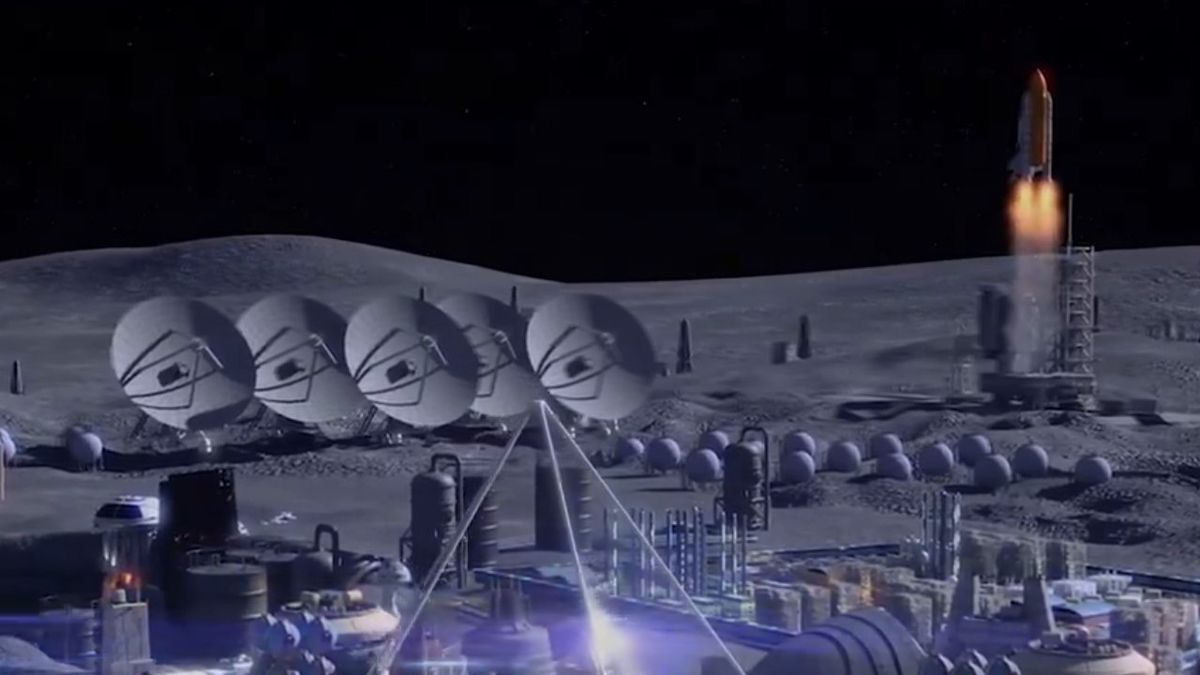



The ‘Fiddler on the Moon’ documentary examines how Judaism could evolve as humanity ventures into space.
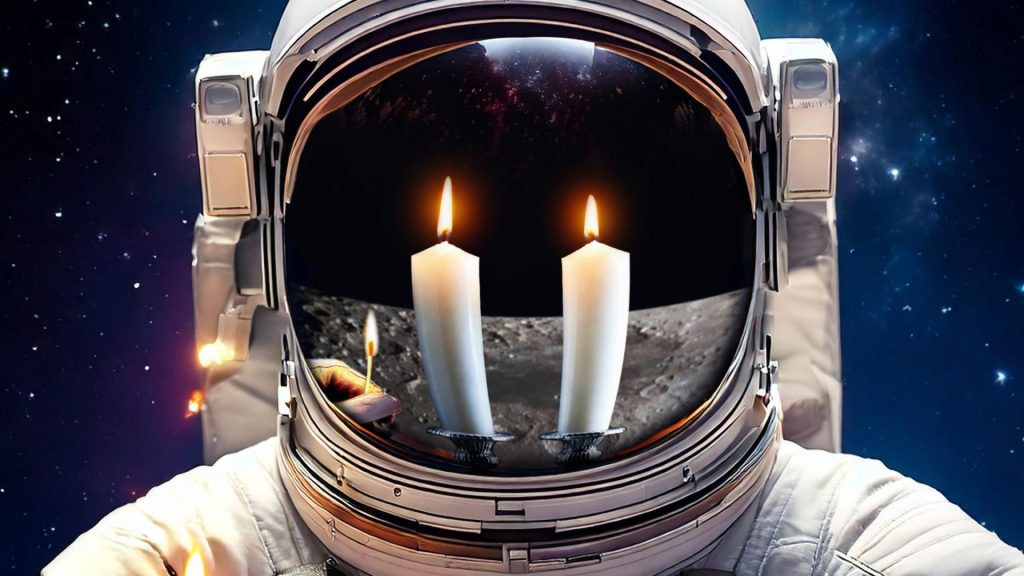
‘Fiddler on the Moon’ documentary explores how Judaism might adapt as humanity reaches out into space (Image Credit: Space.com)
A new documentary short from directors Seth Kramer, Daniel Miller and Jeremy Newberger asks a simple question: What does Judaism look like in a society traveling into space, or living on other planets?
“Fiddler on the Moon: Judaism in Space” investigates how the religion would adapt to spaceflight and environments where celestial indicators like sunset or the phase of the moon, around which many Jewish traditions are centered, become inaccessible or inapplicable for life off Earth.
The filmmakers behind “Fiddler on the Moon” say the themes of the documentary are as old as religion itself. “Everyone sort of thinks that faith and science don’t intersect,” Miller told Space.com. “This film helps show that they are working in concert, that they always have been and continue to advance one another.”
Much of the documentary focuses on Israeli astronaut Ilan Ramon, and how he addressed this question during his STS-107 mission aboard space shuttle Columbia, which tragically ended in the loss of the spacecraft and crew during their reentry on Feb. 3, 2003.
Before his flight, Ramon consulted Rabbi Zvi Konikov, from Chabad of the Space and Treasure Coasts, located down the road from NASA’s Kennedy Space Center, in Florida. “He asked me for a favor,” Konikov says of Ramon in the documentary. “‘How do I mark the Sabbath in space?’”
Jewish holidays begin and end at sunset, and are followed according to a lunar calendar — an easy system to follow on Earth, but exponentially more complicated if you’re in orbit experiencing 16 sunsets a day, and even more so if you happen to be on the moon.
“All of our reckoning of time owes its foundations to astronomical observations that are Earth-centered,” Tyson said in the film. “One should not be surprised at the challenge attempting to maintain religious observance traditions in places other than Earth.”

Ramon’s conundrum had precedent, the film shows, in rabbinical decisions from World War II, when Jewish soldiers stationed near the North Pole sought a solution for observing Shabbat in a region where the sun rarely sets. The rabbis’ guidance then was to follow the time of the closest habitable city. In the soldiers’ case, this worked out to be Anchorage, Alaska. For Ramon, Rabbi Konikov suggested following the clock in mission control, based in Houston, Texas.
The question of how Jews adhere to religious observances in space, however, is one that far predates Ramon’s spaceflight. “We thought it was a silly idea at first, Jews in space,” Miller said of the film’s inception. “But then, as we sort of started researching, we realized that Talmudic scholars, academics, rabbis — they’ve been discussing that idea forever … It was with the 1969 moon landing when it really came to the fore.”
Now, more than 50 years since humanity first stepped foot on the moon, serious momentum to return us to our nearest celestial neighbor and beyond are eliciting new questions like if and how one might follow the Jewish lunar calendar on a planet like Mars, where the moons are just tiny points of light in the sky and the day/night cycle is about 40 minutes longer than Earth’s 24-hour rotation.
“It is so close to Earth and yet just slightly off enough so that sooner or later, you’re going to go out of sync with the Jewish community on Earth,” said “Sci-fi” Rabbi Josh Breindel in the film.
“No matter what your traditions are, someone is going to break them,” Tyson said. He was recalling the impression left on him after seeing the famous musical from which “Fiddler on the Moon” draws inspiration for its name, but the quote extends beyond just Judaism.
Tyson pointed to other religions’ customs, like the Muslim practice of praying five times a day or Catholics attending mass, as significant contributory components to communities here on Earth. “It kind of matters that everybody’s doing the same thing at the same time,” he said. “There’s a unifying force that that represents. That seems to matter. And if that’s the case, why not let it continue to matter?”
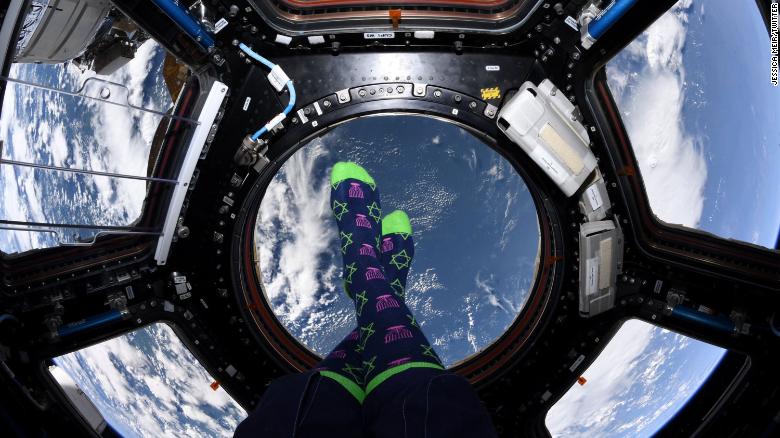
Questions of how to practice religion in space may feel like far future concepts, but from Ramon marking Shabbat in space, to Jewish NASA astronaut Jessica Meir’s viral Chanukah socks photo taken aboard the International Space Station (ISS), answers for these otherworldly inquiries are needed sooner rather than later.
During the same mission Meir snapped those Chanukah socks in 2019, she also conducted the first ever all-woman spacewalk in history. She did so with fellow NASA astronaut Christina Koch, who is currently scheduled to launch around the moon as early as February 2026 as a part of the Artemis 2 mission. NASA is planning another moon mission, Artemis 3, in 2028, which will land astronauts on the lunar surface, and is developing the architecture for an eventual permanent human presence there.
And it may be that history has prepared the Jewish people for that milestone. “Fiddler on the Moon” argues that not only is the Jewish religion equipped for the future of space travel, but that such a transition would not be too dissimilar to other mass migrations forced on the Jewish people in the past.
“Jews have a genius for adapting under the harshest conditions, whether it’s imposed by people, or whether it’s imposed by nature,” Rabbi Ben-Tzion Spitz, creator of the Mars Jewish calendar, said in the documentary. And, indeed, Jewish history is fraught with stretches of harsh conditions, including persecution, exile and extermination.
“Jews are always confronted by forces that threaten them when they stay,” the film’s directors said in a statement. It’s a history that has led many Jews to immigrate to Israel/Palestine, where the emergence of Kibbutzim — small, agricultural, socialist communities focused on self-sustainment and shared labor — took root in the early 20th century as safe havens from anti Semitism, and still exist today.
In the film, Meir talks about her own family’s journey of escaping religious discrimination. “My father was born in Baghdad in 1925 when a lot of the anti-Semitism was kind of starting in the region,” she explained. “They all left for Israel. That’s really where my father grew up.”
“When you get to space, you’re going to want to share as many things as possible,” Kelly Weinsersmith, co-author of “A City on Mars,” points out in the film. “It sort of makes sense to start this off as a communal movement. Kibbutzim will be important for learning how to do that.”
“Fiddler on the Moon” leaves viewers wondering if the Jews’ history and hardships will follow them into the space age, or if humanity will be able to evolve alongside our furthering reach into the solar system.
“Once we start settling other planets, maybe the Jewish experience will change. Hopefully we can evolve beyond this history of persecution, of people being singled out for being different,” Meir said.
The world premiere of “Fiddler on the Moon” took place at the Boca International Jewish Film Festival, in Florida, in February, and has since been nominated for the 2025 Critics Choice Documentary Awards, and won multiple awards for best documentary short.
“We have found, in general, that people have really been kind of excited about the movie,” Miller said. “It’s not only at Jewish festivals, but it’s at science festivals, faith festivals, mainstream festivals, and it’s really been kind of sparking a fire.”
The film is currently touring the U.S., with appearances from coast to coast scheduled through April 2026.